
Jass Club
A Short History of Jass
How a Dutch soldiers' game became Switzerland's national pastime.
Nothing feels more Swiss than a Jass table on a Sunday afternoon. Yet the game is not Swiss by birth: it came from the Netherlands, carried home in the packs of Swiss mercenaries at the end of the 18th century.
What the Swiss did was make it their own, with their own cards, their own words, and more than fifty ways to play.
Timeline
Five centuries at the card table
c. 1490
The oldest Swiss cards
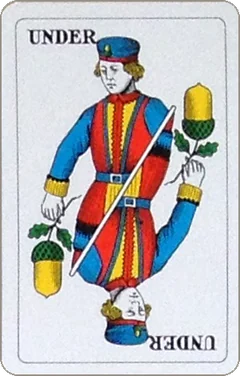
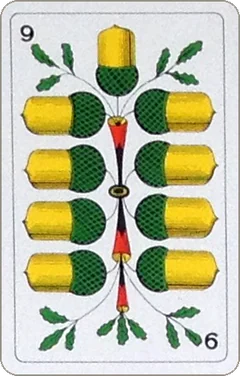
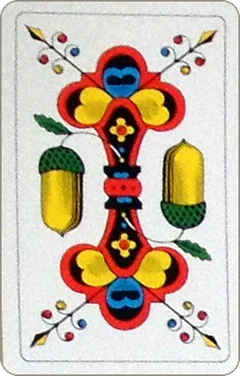
The oldest known Swiss playing cards come from Basel, made for the merchant Heinrich Halbisen. They already carry the four Swiss-German suits we still play with today: Roses, Acorns, Shields and Bells.
15th century
The Kaiserspiel
Long before Jass, the Swiss played the Kaiserspiel, a trump game popular with the mercenaries on their Italian campaigns. It had a cheeky twist: the trump Under, the farmer, beat the King.
18th century
The age of Tarock
For a while the Italian game Tarock was the fashion, especially in Solothurn.
1693–1796
Swiss regiments in Dutch service
For a century, Swiss regiments served the Dutch Republic. In the Netherlands the soldiers met a family of card games where the Jack of trump, the Jas, was the highest card.
Late 1700s
Jass comes home
In the last third of the 18th century, Protestant mercenaries returning from Dutch service brought the game home, played with 36 cards. After the Dutch Republic fell in 1795, the remaining five Swiss regiments were dissolved and most of the men returned to Switzerland in 1796 and 1797.
1796
The first written record
In Siblingen, in the canton of Schaffhausen, two farmers accused by the local clergy of playing cards for wine confessed to a game “which people call Jassen”. It is the oldest known mention of Jass in Switzerland.
19th century
The national game
Jass pushes Tarock aside and becomes Switzerland's most popular card game, played in every class and every region (least in Ticino, where Scopa and Tressette rule), with more than 50 sets of rules, Schieber and Pandur among them.
1967
Jass on television
Kurt Felix creates Samschtig-Jass for Swiss television, today the oldest entertainment programme still on air in Europe. It celebrated its 1000th episode on January 4, 2025.
1969
Swiss championships
The first national Jass championships are held.
2014
A coin for Jass
Swissmint issues a 20-franc silver coin dedicated to Jass. A 2012 survey had found that 63% of German-speaking Swiss can play, and 41% play regularly.
Words from Holland
The game still speaks Dutch
The best proof of where Jass comes from is hidden in its words. The names of its two strongest cards came straight from the Dutch games the mercenaries learned.
Jass
Dutch jas
The Jack of trump, the highest card. The game took its name from it.
Nell
Dutch nel
The 9 of trump, second only to the Jack.
Buur
Swiss German, farmer
The Swiss name for the same Jack of trump, a memory of the Kaiserspiel's farmer who beat the King.
One Game, Two Decks
Roses or Hearts?
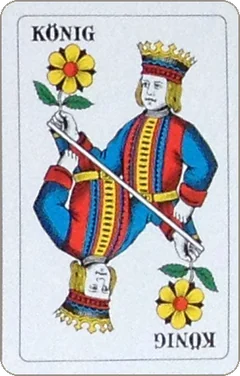
Ask a Swiss which cards are the real ones and you will learn where they grew up. Eastern and central Switzerland play with the old Swiss-German suits. The west, Bern, Solothurn, Basel, Valais, Aargau, Ticino and the Thurgau shore of Lake Constance, play with French suits.
One reason: in the 18th century France taxed playing cards, and card makers moved into the Confederation, where there was no such tax. Their French-suited cards spread through western Switzerland. In the Zurzibiet, the Aare river long marked the line, and it stayed there even after the first bridge was built in 1892.
And Now in Arizona
The story continues at our tables
More than two centuries after it reached Siblingen, Jass travelled with Swiss emigrants around the world. In the Valley of the Sun, our Jass Club keeps the game going, and passes it on to the next generation.
Sources
- Historisches Lexikon der Schweiz, “Jass” (Peter F. Kopp)
- Swiss National Museum blog, “Before Jass”
- Burgenverein Untervaz, “Die Schweizer Regimenter in holländischen Diensten”
- Blick, on the origins of Jass
- Blick, on the French and Swiss-German card divide
- SRF, Samschtig-Jass programme portrait
- Swissmint, 2014 Jass commemorative coin